Laman

Tampilkan postingan dengan label Special Places. Tampilkan semua postingan

Rabu, 26 Juni 2013

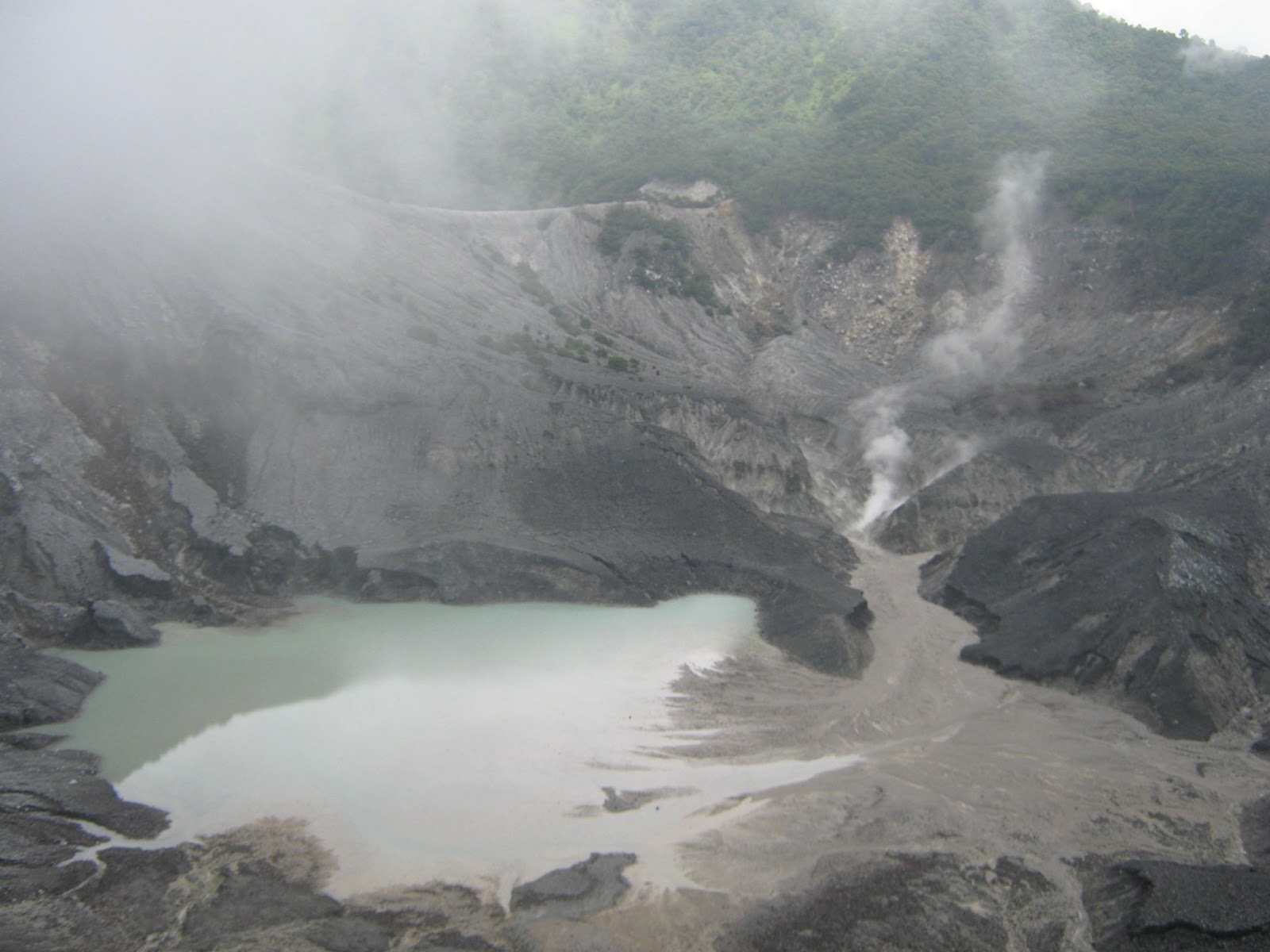
MOUNT TANGKUBAN PERAHU


The origins of mount Tangkuban Perahu, associated with Sangkuriang legend, narrated in love with his mother, Dayang Sumbi. To thwart his intentions to marry her, Dayang Sumbi stipulating that Sangkuriang make the boat overnight. When his efforts failed, Sangkuriang angry and kicked the boat that landed upside-down. The boat is then formed mount Tangkuban Parahu.

This Tangkuban Perahu including active volcanoes whose status is constantly monitored by the Indonesian Directorate of Volcanology. Some crater is still showing signs of activity of this mountain. Among the signs of volcanic activity is the appearance of sulfur gases and hot springs at the foot of the mountain, of which is in kasawan Ciater, Subang.

The existence of this mountain topography and Bandung, which is a basin with hills and mountains on each side strengthens the theory of the existence of a large lake that is now the Bandung area. Believed by geologists that the plateau region Bandung with a height of approximately 709 m above sea level is the remnant of a huge lake formed by the damming of Ci Tarum by ancient volcanic eruptions, known as Mount Sunda and Tangkuban Parahu be remnants of ancient Mount Sunda which is still active. This phenomenon can be seen on Mount Krakatau in the Sunda Strait and Ngorongoro district in Tanzania, Africa. So the legend Sangkuriang which is the story of the region is believed to be a documentation of the Sundanese Ancient Mountain area at the time of the incident.

Mount Tangkuban Parahu have a height of 2,084 meters. This mountain is Stratovulcano form with the eruption center that moved from east to west. Rock types issued by the eruption mostly lava and sulfur, a mineral that is issued sulfur, a mineral that was issued when the mountain is not active is sulfur vapor. The average daily temperature is 17 ° C during the day, and 2 ° C at night.


~~~~~~~ Thank's ~~~~~~~


Minggu, 16 Juni 2013

Borobudur Tample

Borobudur, or Barabudur, is a 9th-century Mahayana Buddhist Temple in Magelang, Central Java, Indonesia. The monument consists of six square platforms topped by three circular platforms, and is decorated with 2,672 relief panels and 504 Buddha statues. A main dome, located at the center of the top platform, is surrounded by 72 Buddha statues seated inside a perforated stupa.

Built in the 9th century during the reign of the Sailendra Dynasty, the temple's design in Gupta architecture reflects India's influence on the region. It also depicts the gupta style from India and shows influence of Buddhism as well as Hinduism. The monument is both a shrine to the Lord Buddha and a place for Buddhist pilgrimage. The journey for pilgrims begins at the base of the monument and follows a path around the monument and ascends to the top through three levels symbolic of Buddhist cosmology: Kāmadhātu (the world of desire), Rupadhatu (the world of forms) and Arupadhatu (the world of formlessness). The monument guides pilgrims through an extensive system of stairways and corridors with 1,460 narrative relief panels on the walls and the balustrades.

Evidence suggest Borobudur was constructed in the 9th century and abandoned following the 14th century decline of Hindu kingdoms in Java, and the Javanese conversion to Islam. Worldwide knowledge of its existence was sparked in 1814 by Sir Thomas Stamford Raffles, then the British ruler of Java, who was advised of its location by native Indonesians. Borobudur has since been preserved through several restorations. The largest restoration project was undertaken between 1975 and 1982 by the Indonesian government and UNESCO, following which the monument was listed as a UNESCO World Heritage Site. Borobudur is still used for pilgrimage; once a year Buddhists in Indonesia celebrate Vesak at the monument, and Borobudur is Indonesia's single most visited tourist attraction.

In Indonesian, ancient temples are referred to as candi; thus locals refer to "Borobudur Temple" as Candi Borobudur. The term candi also loosely describes ancient structures, for example gates and baths. The origins of the name Borobudur however are unclear, although the original names of most ancient Indonesian temples are no longer known. The name Borobudur was first written in Sir Thomas Raffles' book on Javan history. Raffles wrote about a monument called borobudur, but there are no older documents suggesting the same name. The only old Javanese manuscript that hints at the monument as a holy Buddhist sanctuary is Nagarakretagama, written by Mpu Prapanca in 1365.

The name Bore-Budur, and thus BoroBudur, is thought[by whom?] to have been written by Raffles in English grammar to mean the nearby village of Bore; most candi are named after a nearby village. If it followed Javanese language, the monument should have been named 'BudurBoro'. Raffles also suggested that 'Budur' might correspond to the modern Javanese word Buda ("ancient")—i.e., "ancient Boro". However, another archaeologist suggest the second component of the name (Budur) comes from Javanese term bhudhara (mountain).

The construction and inauguration of a sacred Buddhist building—possibly a reference to Borobudur—was mentioned in two inscriptions, both discovered in Kedu, Temanggung Regency. The Karangtengah inscription, dated 824, mentioned a sacred building named Jinalaya (the realm of those who have conquered worldly desire and reached enlightenment), inaugurated by Pramodhawardhani, daughter of Samaratungga. The Tri Tepusan inscription, dated 842, is mentioned in the sima, the (tax-free) lands awarded by Çrī Kahulunnan (Pramodhawardhani) to ensure the funding and maintenance of a Kamūlān called Bhūmisambhāra. Kamūlān is from the word mula which means 'the place of origin', a sacred building to honor the ancestors, probably those of the Sailendras. Casparis suggested that Bhūmi Sambhāra Bhudhāra, which in Sanskrit means "The mountain of combined virtues of the ten stages of Boddhisattvahood", was the original name of Borobudur. 
Borobudur stupas overlooking a mountain. For centuries, it was deserted.
An 1895 hand-tinted lantern slide of a guardian statue at Borobudur (Photograph by William Henry Jackson). This dvarapalastatue once found on Dagi Hill.
The first photograph of Borobudur byIsidore van Kinsbergen (1873) after the monument was cleaned up
\